

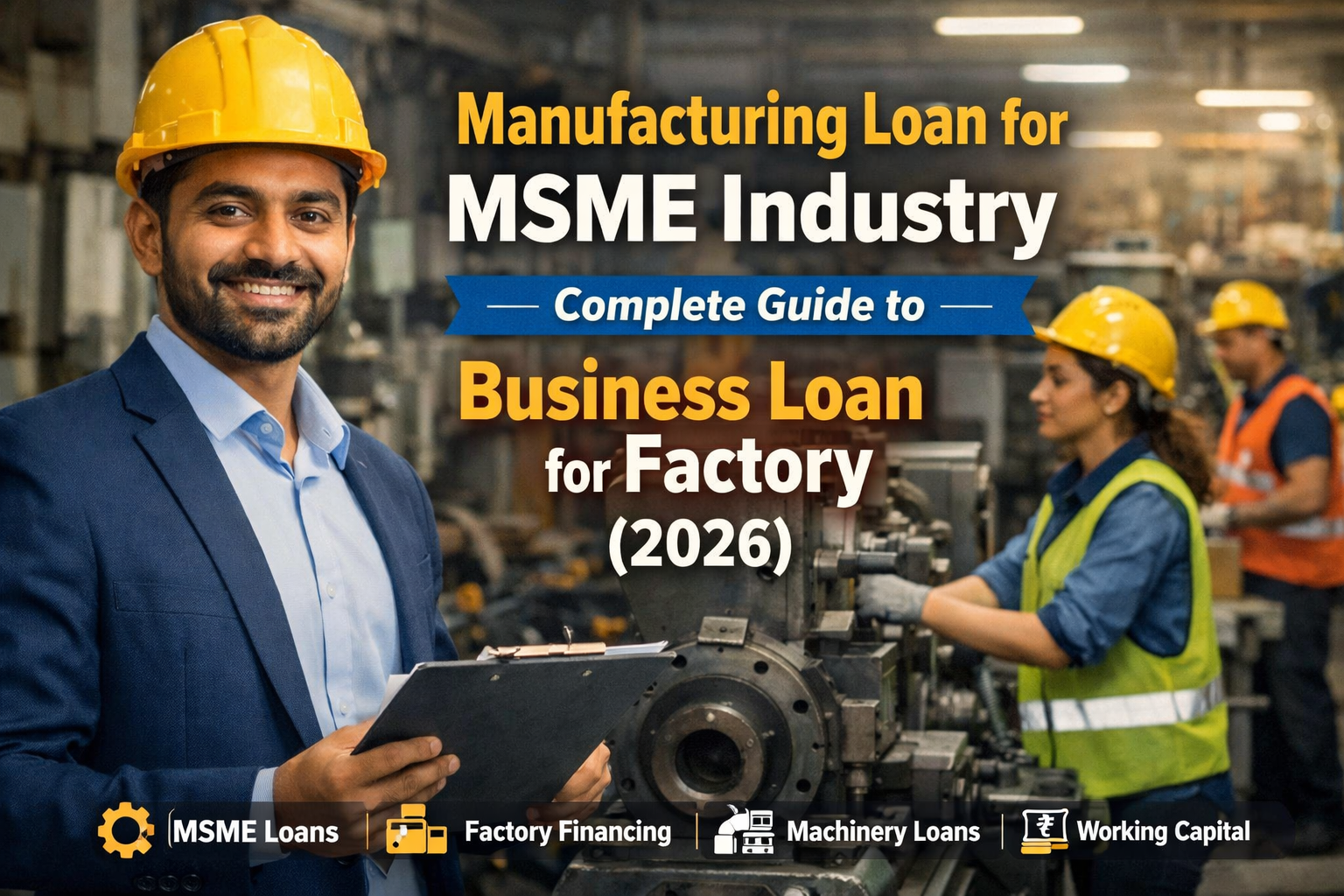
Starting or expanding a manufacturing business in India requires significant investment. From purchasing machinery to managing day-to-day operations, funding plays a critical role in success. This is where a manufacturing loan becomes essential for entrepreneurs and MSMEs.
Whether you are launching a new unit or scaling an existing one, understanding the different types of loans available—such as an MSME loan for manufacturing, machinery loan India, or working capital loan manufacturing—can help you make the right financial decision.
In this detailed guide, we’ll break down everything you need to know about getting a business loan for factory, eligibility, benefits, and how to apply successfully in 2026.
A manufacturing loan is a type of financial assistance specifically designed for businesses involved in production or manufacturing activities. It helps cover expenses like:
Purchasing machinery and equipment
Setting up factory infrastructure
Hiring labor and workforce
Managing raw material costs
Handling operational expenses
These loans are offered by banks, NBFCs, and government schemes to support industrial growth.
MSMEs are the backbone of India’s economy, but they often face challenges like limited capital and high operational costs. A small manufacturing business loan helps overcome these barriers by providing:
Immediate access to funds
Flexible repayment options
Support for business expansion
Improved cash flow management
For startups, a startup manufacturing loan can be the first step toward building a sustainable business.
An MSME loan for manufacturing is designed for micro, small, and medium enterprises engaged in production activities. These loans can be used for both expansion and working capital needs.
Key Benefits:
Lower interest rates
Government support schemes
Minimal documentation
A business loan for factory is ideal for setting up or expanding factory infrastructure. This includes construction, renovation, or upgrading facilities.
Best For:
New factory setup
Expanding production units
Upgrading manufacturing processes
A machinery loan India helps businesses purchase or upgrade machinery and equipment required for manufacturing.
Features:
Covers heavy machinery costs
Flexible tenure options
Quick approval process
This loan is crucial for improving productivity and maintaining competitiveness.
A working capital loan manufacturing is used to manage day-to-day operations like:
Paying salaries
Purchasing raw materials
Managing inventory
Handling utility bills
This ensures smooth business operations without cash flow interruptions.
An industrial loan India is suitable for large-scale manufacturing units and industries requiring substantial capital investment.
Used For:
Large production units
Infrastructure development
Industrial expansion
The government-backed mudra loan manufacturing scheme supports small businesses and startups.
Loan Categories:
Shishu (up to ₹50,000)
Kishor (₹50,000 to ₹5 lakh)
Tarun (₹5 lakh to ₹10 lakh)
This is one of the best options for small manufacturers with limited capital.
A startup manufacturing loan is designed for new entrepreneurs entering the manufacturing sector.
Advantages:
Easy eligibility criteria
Government-backed schemes
Support for innovation and growth
To apply for a manufacturing loan, you generally need to meet the following criteria:
Business must be registered (Udyam/MSME recommended)
Age: 21 to 65 years
Good credit score (650+)
Stable business plan
Minimum business vintage (for some loans)
Startups applying for a startup manufacturing loan may need to present a strong project report.
For most MSME loan for manufacturing applications, you’ll need:
Aadhaar Card
PAN Card
Business registration proof
Bank statements (last 6–12 months)
Income proof / financial statements
Project report (for factory setup)
Having proper documentation speeds up loan approval.
A small manufacturing business loan provides quick funds to meet urgent business needs.
Loans help scale production capacity and increase profits.
A working capital loan manufacturing ensures smooth operations without financial stress.
A machinery loan India allows businesses to invest in modern equipment.
Schemes like mudra loan manufacturing offer subsidies and lower interest rates.
Identify Your Needs
Decide whether you need a business loan for factory, machinery loan, or working capital support.
Choose the Right Loan Type
Select from options like industrial loan India or startup manufacturing loan.
Prepare Documents
Keep all required documents ready.
Apply Online/Offline
Submit your application through a bank or NBFC.
Loan Approval & Disbursal
Once approved, funds are credited to your account.
Maintain a good credit score
Submit accurate documents
Register under MSME/Udyam
Prepare a strong business plan
Avoid existing loan defaults
These steps increase your chances of getting an MSME loan for manufacturing quickly.
Applying without proper documentation
Choosing the wrong loan type
Ignoring repayment capacity
Not comparing lenders
Over-borrowing
Avoiding these mistakes ensures better financial stability.
Setting up a new factory
Expanding production lines
Purchasing machinery
Managing operational costs
Hiring workforce
A business loan for factory can transform small businesses into large-scale operations.
With government initiatives like “Make in India” and MSME support schemes, the demand for industrial loan India and startup manufacturing loan is expected to rise.
Digital lending platforms are also making it easier to access funds quickly with minimal paperwork.
A manufacturing loan is a powerful financial tool for businesses looking to grow in the industrial sector. Whether you need a machinery loan India, a working capital loan manufacturing, or a small manufacturing business loan, choosing the right option can significantly impact your business success.
With proper planning, documentation, and financial discipline, you can secure the right MSME loan for manufacturing and take your business to the next level.
A manufacturing loan is financial support provided to businesses involved in production and manufacturing activities.
Source: https://www.investopedia.com/terms/b/business-loan.asp
Any registered MSME engaged in manufacturing can apply.
Source: https://msme.gov.in/
It is a loan used for setting up or expanding factory infrastructure.
Source: https://www.sba.gov/funding-programs/loans
It is a loan specifically for purchasing manufacturing equipment and machinery.
Source: https://www.sidbi.in/en/financial-products
It helps cover daily operational expenses like salaries and raw materials.
Source: https://www.investopedia.com/terms/w/workingcapital.asp
It is a large-scale loan designed for industrial and manufacturing businesses.
Source: https://www.ibef.org/industry/indian-manufacturing-industry-analysis
It is a government-backed loan scheme for small manufacturing businesses.
Source: https://www.mudra.org.in/
Yes, through a startup manufacturing loan.
Source: https://www.startupindia.gov.in/
It varies depending on the lender and loan type.
Source: https://www.rbi.org.in/
Some loans are collateral-free, especially under government schemes.
Source: https://www.cgtmse.in/
It can take from a few days to a couple of weeks.
Source: https://www.hdfcbank.com/personal/borrow/popular-loans/business-loan
Aadhaar, PAN, bank statements, and business proof are commonly required.
Source: https://udyamregistration.gov.in/
Yes, but having Udyam registration improves approval chances.
Source: https://msme.gov.in/know-about-msme
It depends on the loan type and eligibility.
Source: https://www.psbloansin59minutes.com/
Yes, through a machinery loan India.
Source: https://www.sidbi.in/en/financial-products
In many cases, yes, especially for larger loans.
Source: https://www.gst.gov.in/
Yes, through a business loan for factory.
Source: https://www.icicibank.com/business-banking/loans/business-loan
It typically ranges from 1 to 10 years.
Source: https://www.axisbank.com/business-banking/loans/business-loan
Yes, including mudra loan manufacturing and MSME schemes.
Source: https://www.india.gov.in/topics/finance-taxes/loans
Maintain a good credit score, proper documentation, and a solid business plan.
Source: https://www.cibil.com/
We value your feedback! Help others by leaving a quick Google review.
Write a Review on Google